Particle size segregation and spontaneous levee formation in geophysical mass flows
Add to your list(s)
Download to your calendar using vCal
If you have a question about this talk, please contact Dr Ed Brambley.
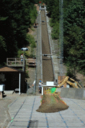
Hazardous geophysical mass flows, such as snow avalanches, debris-flows and pyroclastic flows, often spontaneously develop large particle rich levees that channelize the flow and enhance their run-out. Measurements of the surface velocity near an advancing flow front have been made at the United States Geological Survey (USGS) debris-flow flume, where 10m$^3$ of water saturated sand and gravel are allowed to flow down an 80m chute onto a run-out pad. In the run-out phase the flow front is approximately invariant in shape and advances at almost constant speed. By tracking the motion of surface tracers and using a simple kinematic model, it was possible to infer bulk motion as incoming material is sheared towards the front, over-run and shouldered to the side. At the heart of the levee formation process is a subtle segregation-mobility feedback effect. Simple models for particle segregation and the depth-averaged motion of granular avalanches are described and one of the first attempts is made to couple these two types of models together. This process proves to be non-trivial, yielding considerable complexity as well as pathologies that require additional physics to be included.
This talk is part of the Fluid Mechanics (DAMTP) series.
This talk is included in these lists:
Note that ex-directory lists are not shown.
|
![[Search]](http://talks.cam.ac.uk/images/search.gif?1209136071) |
|![[A-Z Index]](http://talks.cam.ac.uk/images/az.gif?1209136071) |
|![[Contact]](http://talks.cam.ac.uk/images/contact.gif?1209136071)
![[University of Cambridge]](http://talks.cam.ac.uk/images/identifier2.gif?1209136071)
![[Talks.cam]](http://talks.cam.ac.uk/images/talkslogosmall.gif?1209136071)

 Nico Gray (Manchester)
 Friday 04 November 2011, 16:00-17:00