|![[Search]](http://talks.cam.ac.uk/images/search.gif?1209136071) |
|![[A-Z Index]](http://talks.cam.ac.uk/images/az.gif?1209136071) |
|![[Contact]](http://talks.cam.ac.uk/images/contact.gif?1209136071)
||![[University of Cambridge]](http://talks.cam.ac.uk/images/identifier2.gif?1209136071) |
COOKIES: By using this website you agree that we can place Google Analytics Cookies on your device for performance monitoring. | ![[Talks.cam]](http://talks.cam.ac.uk/images/talkslogosmall.gif?1209136071) |
University of Cambridge > Talks.cam > Darwin College Science Seminars > Reconstructing late Middle Pleistocene human environments using evidence from land and freshwater molluscs
Reconstructing late Middle Pleistocene human environments using evidence from land and freshwater molluscsAdd to your list(s) Download to your calendar using vCal
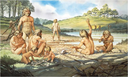
If you have a question about this talk, please contact Dr James Kirkbride. The late Middle Pleistocene period is characterized by significant climatic fluctuations, alternating between glacial conditions (ice ages) and interglacial periods similar to the present day. Four distinct interglacials are apparent within the British late Middle Pleistocene geological record; early human populations were able to colonize Britain during three of these temperate periods, but were conspicuously absent during the most recent, the Ipswichian interglacial. The deposits preserved in the famous gravel pits around Swanscombe, Kent, have yielded some of the most important evidence for hominin occupation during the Hoxnian interglacial (~440 ka), the temperate period that immediately followed the major Anglian glaciation. The site is most notable for the discovery of a human skull, a rarity within the British Palaeolithic record. Furthermore, two distinct assemblages of stone tools suggest that separate groups of early humans colonized the Thames valley. The fossiliferous sediments at Swanscombe have preserved rich molluscan and vertebrate assemblages which allow reconstructions of the prevailing climatic and environmental conditions. They also allow inferences about sea level and palaeogeography to be made. An important element of the molluscan succession at Swanscombe is the so-called ‘Rhenish suite’ of aquatic snails, now found in central and southern Europe, which suggest that the Thames was confluent with continental rivers during the early part of the interglacial. The onset of estuarine conditions in the Lower Thames, implying a rise in sea-level in the North Sea, is indicated by the appearance of ostracod and fish species that inhabit brackish water. These data have important implications for understanding the palaeoenvironmental conditions under which humans were able to colonized Britain and northwest Europe. This talk is part of the Darwin College Science Seminars series. This talk is included in these lists:
Note that ex-directory lists are not shown. |
Other listsMicrosoft Research PhD Scholars CSaP Professional Development Policy Seminars Department of Psychiatry & CPFT Thursday Lunchtime SeminarOther talksRetinal mechanisms of non-image-forming vision Holonomic D-modules, b-functions, and coadmissibility Hunting for cacti in the caribbean The Galactic Centre: a template for understanding star formation and feedback in a high-pressure environment Interrogating T cell signalling and effector function in hypoxic environments Brest-Litovsk and the Making of Modern Ukraine and Russia EU LIFE Lecture - "Histone Chaperones Maintain Cell Fates and Antagonize Reprogramming in C. elegans and Human Cells" Graded linearisations for linear algebraic group actions Towards bulk extension of near-horizon geometries The Rise of Augmented Intelligence in Edge Networks Glucagon like peptide-1 receptor - a possible role for beta cell physiology in susceptibility to autoimmune diabetes Beyond truth-as-correspondence: realism for realistic people |


 Thursday 27 May 2010, 13:00-14:00